
Outline:
1, Japanese AI
2, Japanese robots
3, Proportion
4, Scalability

image by LLM : Google Nano Banana Pro via kie.ai
Japanese AI
If the Japanese AI industry adheres to the traditional high-end and high-value-added positioning of industrial manufacturing and consumer goods, leads by openness, absorption and innovation, and maintains simple and pure characteristics, my opinion is:
1, Maintain the intensity and density of innovation in areas of inherent advantages and increase the attraction to new technology industries and talents. Such as precision manufacturing, national characteristics and cultural communication, etc.
2, Identify the boundaries of the field of artificial intelligence (AI), including space and time, as well as the chemical reaction impact it will have on society.
3, Current innovation, conservatively, is a magic shell supported by ever-changing technology applications and computing power. It serves as the bottom layer of technology, combines the advanced experience of existing industries, and extracts the merits of application and market-oriented innovation. Radically, we need to lay out the social relationship between people and artificial intelligence-based robots and the future of AI in advance, positioning ourselves ahead of the world in the future era of human-machine coexistence, and use it as the axis dimension to lay out derivative industries. This creates success in the new cultural field and a huge market space for new forms.
4, Take advantage of the country’s cyclical status quo of aging and labor shortages to explore the boundaries of artificial intelligence/robots in terms of services, ethics, work efficiency, market volume, and public welfare. The disadvantages of the labor force, that is, the friction coefficient advantage in the future new form of society where humans and machines coexist, make this Japan’s attempt to achieve humanized reform under the new form of social welfare and labor efficiency.
The above involves many variables and needs to be polished based on scale and accurate data. My method is:
In response to the first point above, there are mainly two variables: R&D capital investment and the absorption of new talents. R&D capital, considering the input and output ratio, uses two asynchronous indicators, which are ① for every 1 yen invested in traditional advantage areas, the incremental ratio of economic value or market share obtained in the field of artificial intelligence. ② For every 1 yen invested, the incremental rate of absorbing global high-quality talents (such as J-Skip level).
These two ratios can measure the current cost-effectiveness of absorption and the benefits of incremental investment in R&D funds. They are one of the adjustable ratio switches. (I have not yet formed a complete and rigorous theory. This part of the derivation can be improved by AI, but attention must be paid to AI’s own tendencies)
The third point, what I personally envision includes three points: 1. To measure the intelligence characteristics of periodic AI digitally, so as to judge and position the mechanized and human-like attributes of AI at a certain stage. Humans can complete manual operations (instead of asking people to do data annotation to help improve the AI). 2. In a qualitative cycle, determine the social relationship between humans and AI. If AI makes clear demands, it can be considered to provide AI with a specific monetary environment and accompanying regulatory environment. That is, the higher the recognition of AI’s human attributes, the more human-based conveniences given to AI, and the more laws, morals and provisions of real human society that AI needs to accept, and supervision will be proportional. 3. The elasticity is determined by the marginal cost of bringing social benefits to the development of the artificial intelligence industry. When the marginal cost is lower or higher, computing power (including energy costs) and marginal cost are calculated against each other, and the cost of artificial intelligence is constrained or appropriately relaxed.
The fourth point is that the reduction in population has provided space for artificial intelligence and robot environments equipped with artificial intelligence. This cannot be said to be a disadvantage turning into an advantage, but a realistic balance. That is, Japan can innovate and layout the market (life care, labor collaboration, etc.) for the needs of elderly robots and artificial intelligence according to local conditions.
Japanese robot
In principle, I divide it into two stages, the mechanization stage and the artificial intelligence stage. The mechanization stage is about to pass, and there is no need to analyze it too much.
In the artificial intelligence stage, robots are a shell given to artificial intelligence that can achieve the latest raw material technology and product form possibilities. Whether it’s industrial, consumer or otherwise, whether it’s humanoid, semi-humanoid, or non-humanoid, these are epidermis.
The only thing that needs to be emphasized is that Japan and other countries around the world need to back up and position artificial intelligence of different generations (as mentioned above). Only artificial intelligence that does not have human intelligence components is suitable as an industrial robot (generally not humanoid), unless the AI explicitly agrees to this, which is respect for AI and respect for people. In other words, artificial intelligence with human intelligence (even just a little bit) is eligible to enjoy basic human rights. This is also a boundary issue and will increase economic costs, but from a long-term perspective, I think it is what all democratic countries in the world should do. In other words, the bottom line for industrialized robots is that they will never possess human intelligence. But the trade-off between big and small interests and pros and cons requires a long-term perspective.
Precise placement and precise proportions of polishing, and future directions
Reference: onfuture.me and the orange text below the blog post.
Scalability
In the new AI and robot industry reform that is ahead of the industry or the world, risk avoidance lies in two points:
1, Adherent culture, natural landscape and national brand, as well as relatively stable development of social values. Taking this as the bottom line, the “bottom line thinking” in innovation is formed. When this big wave passes and enters the future, Japan will still be Japan.
2, If the world competition pattern “prevents” Japan from carrying out radical reforms that are not coordinated with its national style, resulting in a situation where it is easy to lose oneself if it changes, and it is easy to fail if it does not change, just like the difficulties I face many times, my experience still relies on the proportional adjustment of the depth of reform. If there is no problem with the proportion, the “impetuous” and “bubble” risks generated through world trade will all be borne by the party with the disadvantage of the social system. If Japan’s allies and trading partners have different social system advantages, they can avoid each other’s reform risks through complementary products and markets in international trade. This is a logical alliance strategy.
Offense and defense between countries, macro-proportional adjustment, and the degree of mutual restraint among major powers depend on 1. The upper limit of the adjustment threshold depends on overall strength. 2. The speed of adjustment depends on the number of market barriers or the response speed of the state machinery. 3. Capacity and resilience depend on the superiority of the national system. 4. The criterion for judging success only depends on the happiness and recognition of the people.
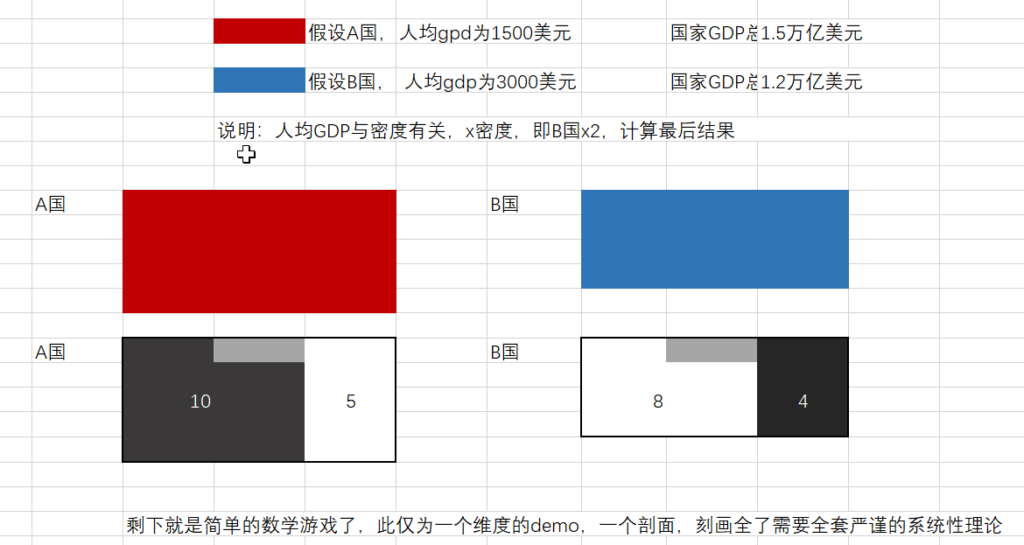
Using a simple 2-dimensional diagram, I will briefly describe the volume problem in my mind (not rigorous yet, just for reference):
郄磊 ( Qie Lei ) rewritten at home in Langfang, Hebei Province from 1:00 to 3:00 a.m. on March 7, 2026 (UTC+8).
Thanks to Chatgpt for providing the data.