

image from baozike.com
Baozike (包子客) is a Northern Chinese (currently) restaurant chain that emphasizes health and hygiene, with its menu centered on the traditional Chinese delicacy “baozi.”
Business Analysis Diagram (Strategies based on my personal experience, generated by XMind AI):
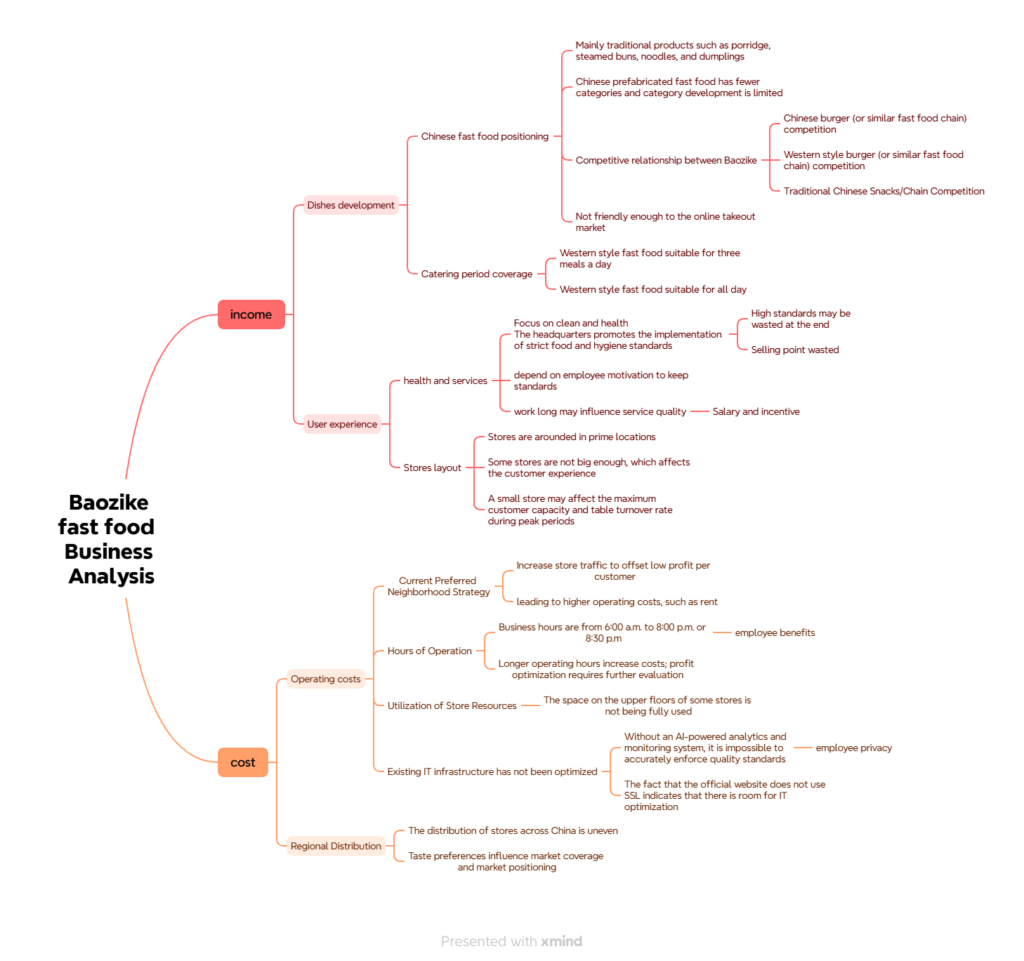
text in model diagram was translated by Google, DeepL, modified by me
This is a general business analysis—not difficult. I’ll explain each point in detail, and later I’ll discuss competitive strategies regarding food and beverage in the context of Chinese and Western cultures.
Model Diagram Analysis
The most important points are:
1, Menu development is constrained by the brand’s positioning, making innovation difficult. The potential for expanding into the takeout market is limited (this point was omitted from the model diagram).
2, Chain expansion is constrained by the menu, resulting in locations primarily centered around commercial districts, which drives up costs.
3, Based on working hours, employees have a heavy workload.
4, The guest experience is influenced by the menu, chain distribution, and the restaurant’s own limitations (such as floor space), as well as service (staff). This includes the maximum seating capacity during peak dining hours.
5, Impact on store layouts and competition nationwide.
6, The impact of point 4 feeds back into points 1, 2, and 3, creating a cycle of irrational accumulation in a highly competitive environment.
7, Under a volume-driven business model and competitive pressure, the menu tends to become conservative in order to maintain profit margins or market share. This is a common issue in both Chinese and Western fast-food chains.
8, Digitalization is primarily limited to integrating off-the-shelf solutions; the company’s in-house IT capabilities lack professionalism—for example, the official website lacks SSL encryption. Additionally, the company has not leveraged relatively affordable AI analytics and monitoring systems to ensure that headquarters’ high standards are implemented more smoothly and effectively across all franchise locations.
Data Sources: 1. In-store customer experience and observations. 2. Brief conversations with servers. 3. Baozike’s official website. 4. Third-party platforms (Baidu Maps, Meituan Takeout, WeChat Official Account, WeChat Mini Program). 5. Google Search.
The Culinary Rivalry Between Chinese and Western Cultures
Traditional Chinese culture emphasizes the harmony of color, aroma, and taste. While my knowledge of culinary studies is limited, I have watched A Bite of China, and during my school days, classmates told me that even a simple bowl of ramen involves “gently lifting and slowly selecting the noodles, with one portion of red and two portions of white”—in short, there are many nuances to it. In other words, Chinese culture embodies the concept of “slowness” in dining (and in many other aspects of life). This isn’t just about the meticulous craftsmanship that goes into preparing dishes; diners also savor the tranquility and serenity of life while enjoying their meal.
Western fast food, on the other hand, emphasizes “speed,” which is also a facet of modern Western commercial culture. In commercial cities with fast-paced lifestyles, efficiency and a strong sense of time are paramount. The core of this “speed” is actually the release and excitement derived from enjoying life.
“Speed” and “slowness,” “expansion” and “contraction”—these are inherently perfect complements. When they merge and draw inspiration from one another, they lead to mutual growth and development. This is also a matter of macro-level analysis and competitive strategy.
Methods: For example, develop more pre-prepared dishes that align with the brand’s positioning (not limited to traditional Chinese styles; innovation inspired by international approaches is also encouraged), reduce employee labor hours (by adjusting store operating hours), and implement pay raises or performance-based incentive schemes. For chain store布局, shifting the balance between prime locations, off-peak hours, and high-volume models can reduce rent costs or enhance user experience and positioning, thereby increasing profit per customer during lunch and dinner. Once the menu is refined, it will be better suited for the takeout market.
This article applies my understanding of 道 “Taoism / Dao” philosophy and Western methodologies.
郄磊 ( Qie Lei )
2026.3.17 AM 0 – AM 1 UTC+8 Modified in 3.18